Chapter 1: The Racial Imperative—
Race Laws in the British Empire
Among the four great early-modern European empires that spanned multiple continents—the Portuguese, Spanish, French, and British—the British Empire stands alone in its refusal to encourage, and frequently its active legal prohibition of, sustained racial integration.
EXTENT OF THE BRITISH EMPIRE IN 1937
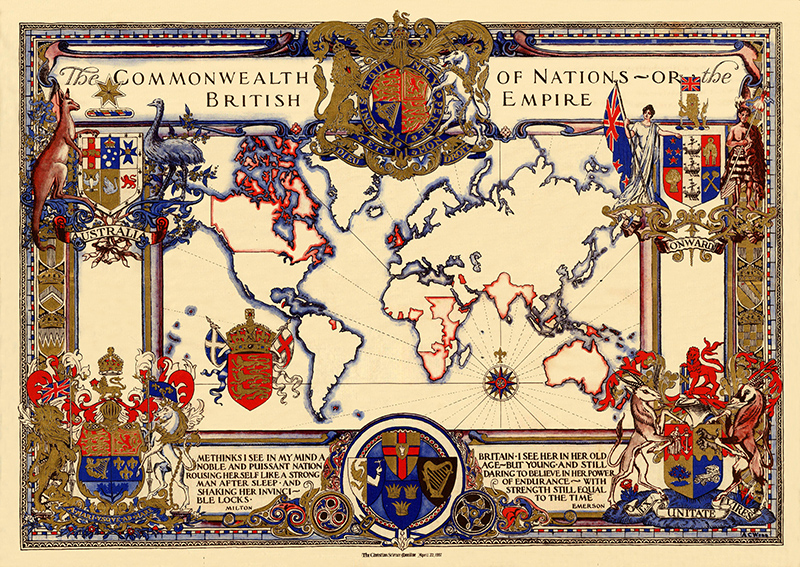
The British Empire in 1937, at its greatest territorial extent—excluding, of course, the Thirteen Colonies on the eastern seaboard of the United States, which won their independence in 1783. The four coats of arms are those of the “Dominions” at that time, the self-governing states that were still part of the empire but not yet fully independent. They are, from top left, clockwise: Australia, New Zealand, South Africa, and Canada.
Whereas the Portuguese, Spanish, and French empires each produced large, legally recognized, and socially visible mixed-race populations (mestiços and mulatos in Brazil and Angola, mestizos and castas in Spanish America, métis and créoles de couleur in Saint-Domingue, Louisiana, and the French Antilles), the British Empire instead erected and maintained a strict system of racial separation.
From the slave codes of 1600s Barbados and Virginia to the Peak District Reservation Ordinance of Hong Kong (1904), the White Highlands of Kenya (1915), the Aboriginal reserves of Queensland (1897), and the European “civil lines” of Georgetown, Rangoon, and Accra, the British Empire’s authorities repeatedly used statutory and administrative segregation to prevent large-scale racial mixing, as opposed to the deliberately racial assimilationist policies of its European rivals.
The contrast is stark. In Portuguese America and Asia, a chronic shortage of European women, the early adoption of concubinage and Christian marriage with Indian and African women, and the Portuguese authorities’ deliberate policy of povoamento (settlement through miscegenation) produced societies in which pardos and mulatos outnumbered pure Whites in many captaincies by the 1700s.
Spanish America codified an elaborate sistema de castas, but simultaneously permitted extensive “racial mobility” through gracias al sacar, or legalized racial intermarriage, and the creation of a large mestizo class that by 1800 constituted the demographic majority in most viceroyalties.
French policy from the Code Noir of 1685 onward recognized free persons of color as citizens (with restrictions that tightened only after 1763), granted them militia commands and property rights, and in Saint-Domingue produced a wealthy affranchi class whose mixed descent was openly touted. In the British Empire, by contrast, such recognition was almost everywhere withheld.
Interracial marriage was never criminalized on the scale of the Spanish Indies’ pragmáticas, but it was socially proscribed and frequently rendered impossible by law: anti-miscegenation statutes existed in every North American colony and most Caribbean islands; in India after 1791 the East India Company forbade European soldiers from bringing Indian wives or children to Britain; in Australia and New Zealand the removal of “half-caste” children was statutory policy; in Africa and Southeast Asia residential ordinances and club rules made family life across the color line all but impossible.
British colonial societies developed powerful norms against intermarriage; created separate legal categories for European and non-European subjects; restricted access to land, office, and political rights on racial lines; and, in many territories, built cities, educational systems, and labor regimes designed to keep populations apart.
While exceptions existed—most notably in parts of West Africa and among the Anglo-Indian community in British India—the general British colonial strategy was to create parallel, not integrated, societies. In addition, even when sexual contact took place, and mixed-race offspring emerged (in small numbers in Africa and among the Anglo-Indian community in British India), the half-castes were denied the status and privileges that their counterparts enjoyed under Iberian or French rule.
Race Laws in British India, 1858–1940
British rule was formalized in India in 1858 when control of the colony was taken from the East India Company. From that time onward, the British “Raj” (a word derived from the Sanskrit word for “kingdom”) was characterized by a pervasive system of racial segregation that separated Europeans from Indians in nearly every sphere of life.
The Indian Civil Service, for example, remained almost exclusively European until the late nineteenth century—mainly because competitive examinations were held only in London, with age limits and educational requirements that automatically excluded most Indians.
BOMBAY EUROPEAN GENERAL HOSPITAL, 1900
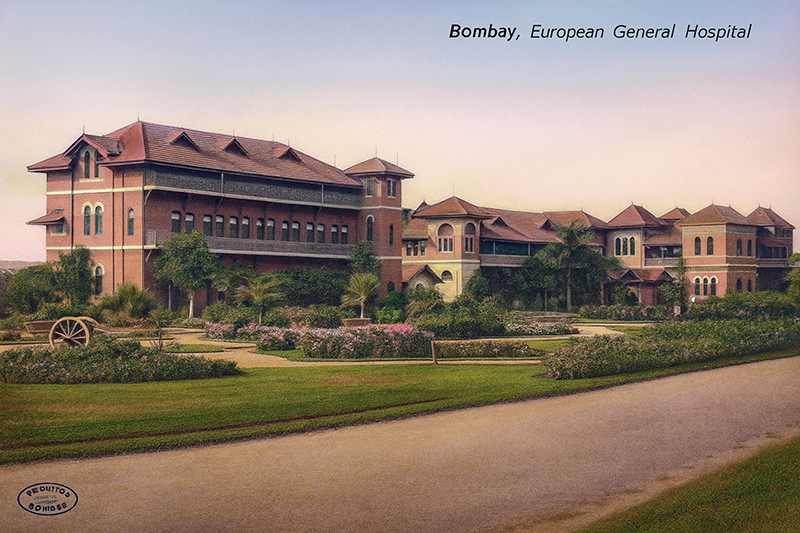
The European General Hospital in Bombay, shown here in a rare 1900 postcard, reflects the racial segregation embedded in British colonial governance. Under the Raj, medical facilities were formally divided into “European” and “Native” institutions, reinforcing the racial hierarchy built into everyday life across the British Empire.
Alongside the formalized legal strictures, an elaborate code of informal segregation governed daily life. European social clubs throughout India (such as the famous Bengal Club, Madras Club, Bombay Gymkhana, etc.) maintained a Whites-only membership until the 1940s.
Winston Churchill, later to be Prime Minister of Britain, noted in his recollection of his military service in India (from 1896 to 1899) that “Indians were not permitted in our clubs; this was understood and accepted by all concerned.”[1] In reality, the Bengal Club had declared as early as 1880 that “The Club exists for the society of gentlemen of European extraction.”[2]
Sanitary and building codes reinforced segregation by limiting Indian residence in European zones. An 1867 Bombay Sanitary Report asserted that “European health cannot be safeguarded without strict spatial separation from the native population.”[3]
Hospitals were also racially segregated, and this rule was strictly enforced after the famous English nurse, Florence Nightingale, wrote to the Secretary of State for India in 1874 that “European soldiers must have hospitals of their own, as the native constitution and native habits are of another character.”[4] In the legal penal system, Europeans convicted of crimes were segregated into special “European wards,” and the Arms Act of 1878 effectively prevented the Indian population from owning firearms, due to the widespread abuse of such weapons among the native population.
All British outposts and settlements were strictly geographically divided by race, by a system known as the “Civil Lines”—colloquially known as “White Town” and “Black Town,” a system that had been in place since the days of British East India Company rule. Indian railways also maintained officially segregated higher-class carriages and waiting rooms labeled “Europeans Only,” a practice that lasted until the 1920s.
In military encampments, official rules demanded segregation: The Punjab Military Handbook (1895) instructed British officers that “Familiarity [with Indian sepoys] is to be avoided; visible separation in quarters and manners must be maintained.”[5]
Race Laws in British Asian Colonies
From the founding of Penang in 1786 to the handover of Hong Kong in 1997, Britain governed a chain of Asian colonies and protectorates that included Singapore, Malaya (the Straits Settlements, Federated and Unfederated Malay States), Hong Kong, Burma (1824–1948), Ceylon (1796–1948), North Borneo, Sarawak, and Brunei.
In every territory the British authorities erected a comprehensive, if locally varying, system of racial segregation that separated Europeans from “Asians” (a category that itself was minutely subdivided into Chinese, Malays, Indians, Ceylonese Tamils, Burmans, Karens, etc.). Segregation was achieved through statute, ordinance, administrative regulation, and deeply entrenched social practice. Residential segregation formed the physical backbone. In Singapore the 1822 Raffles Town Plan explicitly zoned the settlement into European Town, Chinatown, Chulia (Indian), and Arab Kampong districts, a division enforced by land grants and municipal bylaws until the 1920s.
In Penang, Georgetown’s 1801 and 1887 municipal regulations reserved the northern seafront and European civil lines for Whites only. Hong Kong’s Peak District Reservation Ordinance of 1904 legally excluded all Chinese from permanent residence above the 788-foot contour until its repeal under pressure in 1946.
In colonial Rangoon the 1852 Municipal Act and subsequent cantonment rules created European quarters north of the Royal Lake while confining Burmans and Indians to the southern wards. Kuala Lumpur’s Sanitary Board bylaws of 1890–1930 similarly zoned the town into European, Malay, Chinese, and Indian areas.
Public health reasons formed the rationale for many of these rules: the 1887–1907 “Chinese Locations” ordinances in Singapore and the Federated Malay States authorized compulsory segregation of Chinese during outbreaks of bubonic plague, while the 1926–1930 Quarantine and Prevention of Disease Ordinance in Malaya empowered medical officers to declare any “native” area insanitary and evacuate it.
In Ceylon, the outbreak of anti-Muslim riots in 1915 by non-Muslim locals prompted the permanent segregation of “Moorish” quarters in Colombo under emergency regulations that were never fully rescinded.
In Malaya the Indian Immigration Ordinance 1953 (and earlier 1904–1938 versions) bound Tamil estate workers to specific plantations under penal sanctions and a pass system. Chinese tin miners in Perak and Selangor were confined to kongsi compounds under the 1894 Mining Code, and in Burma the 1923 Rangoon Development Trust Act reserved skilled and clerical posts for Europeans and Anglo-Burmans.
Hong Kong’s Peak and European District ordinances were complemented by civil-service segregation: until 1946 no Chinese could rise above the “junior clerical” grade, and separate European and Chinese salary scales persisted into the 1950s.
Public facilities reflected the hierarchy. From swimming pools (such as Singapore’s pool at Katong, which remained for Whites only until the 1950s), to first-class railway carriages and steamer cabins on the Penang–Singapore run, facilities were reserved for Whites until 1941, and Hong Kong’s Star Ferry maintained separate upper-deck (White) and lower-deck (Chinese) accommodation until 1940.
Hospitals everywhere had European wards, with Singapore General Hospital’s European Wing operating until 1955, and a similar wing in the Rangoon General Hospital until 1942.
In Malaya the Courts Ordinance 1948 (and earlier versions) allowed European British subjects to be tried by European magistrates only, while Asians faced local courts. The Singapore Prison Regulations 1872–1950 ordered the maintenance of separate European, Chinese, Indian, and Malay blocks.
Race Laws in British South Africa, 1806–1910
When the British captured the Cape in 1806, they quickly introduced legal instruments aimed at controlling the local nonwhite population. The most important early measure was the Hottentot Proclamation of 1809, often called the Caledon Code, which required the Hottentots (“Khoi”) to carry official documentation (colloquially called “passes”) to either travel or change employers. The text stated that “No Hottentot shall be permitted to quit the service of any master without a certificate of discharge.”[6] The measure was introduced in an attempt to control rampant criminality and vagrancy, which had increased sharply after the abolition of the “inboekstelsel,” a similar system under Dutch rule.
1809: NATIVE CRIME IN CAPE COLONY DRIVES “HOTTENTOT PROCLAMATION”
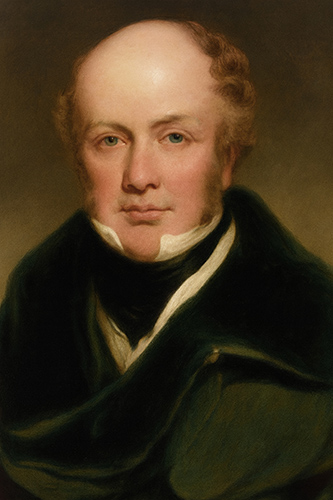
Alexander Du Pré, 2nd Earl of Caledon (1777–1839), British-Irish nobleman and colonial administrator, served as Governor of the Cape Colony from 1807 to 1811. During his tenure he issued the Hottentot Proclamation (commonly known as the Caledon Code) on 1 November 1809. This ordinance required Hottentots (the original inhabitants of Southern Africa, as opposed to the Bantu tribes who arrived must later) to carry “passes” specifying their place of residence and employment. The measure was intended to curb widespread vagrancy and stock theft, had increased sharply after the abolition of the “inboekstelsel,” a similar system under Dutch rule. (From an engraving in the National Portrait Gallery, London, by Charles Turner, after Richard Rothwell, 1840.)
The requirement to carry a written “pass”—later extended to sub-Saharan Africans as well—became a core feature of British racial control and ensured that the “White” areas could be kept clear of large numbers of unemployed nonwhites. British Governor of the Cape, John Cradock (1759–1839), reported to the Colonial Office in London that the “wandering habits” of the nonwhites endangered the colony’s “peace and industry” and that “a system of restraint is indispensable.”[7]
As a result, successive laws passed in the Cape Colony in 1857, 1867, 1871, and 1895 required all Africans entering or residing in towns to carry passes; non-possession of the passes became a criminal offense.
The Hottentots were also regarded by colonial authorities as unable to avoid total alcohol addiction. Ordinance 50 of 1828 contained rules on Hottentot access to alcohol, and subsequent Cape laws in the 1830s through the 1850s criminalized the selling or giving of spirits to Africans without a special permit.
The sub-Saharan African population on the east coast was treated no differently. The Cape Native Beer Act of 1898 made it illegal to sell, give, or barter alcohol to any African except under tightly controlled licensing systems, a measure that had been in place in the Natal colony since the late 1840s.
In 1853, the Cape Colony acquired a new constitution, which, although in theory gave the franchise to all adult males, set such high property and income qualifications that almost all Africans and “Coloureds” (the mixed-race population dating from Dutch rule days) were excluded from the vote. This was reinforced with the 1887 Registration Act and the 1892 Franchise and Ballot Act, which once again raised the qualification threshold to reduce nonwhite voters.
As British control expanded into the eastern seaboard, further racial regulations were introduced. The British Secretary for Native Affairs in the Natal colony, Theophilus Shepstone (1817–1893), was the first to set up defined African living areas, apart from Whites and other races. In an official 1846 communication, he announced that “Natives should not be allowed to roam the white districts at will; their proper place is within the appointed locations.”[8]
The “Law 11 of 1885,” enforced in the Natal colony, prohibited Indians from owning land outside areas designated for them. Then, in 1896, the Natal Franchise Act removed all Indians from the voters’ rolls by requiring voters to have had prior citizenship of a country with representative institutions. As India had never had such institutions, Indians did not qualify.
The discovery of diamonds in 1867 and gold in 1886 transformed racial segregation in the British colonies in South Africa. The employment of large numbers of Africans on the mines created what became known as the “closed compound system.” This consisted of a barracks-type accommodation setup on the mines, isolated from the rest of the settlement. This system served two purposes: it attempted to stop the Africans from stealing diamonds, gold, and equipment, and secondly, segregated the Africans from the White townsfolk.
During the Second Anglo-Boer War, the British resorted to imprisoning the Boer civilian population in an attempt to break the support network for the Boer guerrilla forces. These Boers, mainly women, children, and old men, were held in concentration camps scattered around the country. However, at the same time, all the African laborers who worked on the Boer farms were also held in detention—in segregated camps. The major difference between the two camps was that once the Africans had obtained other employment, they were free to leave. The British victory in that war led to the British colonization of the Boer Republics of the Transvaal and Orange Free State and overall British control over all of what is today the nation of South Africa. By then, the large numbers of Indians that the British had imported as indentured laborers to work in the colony of Natal on the eastern seaboard had made their way to the Transvaal.
AFRICANS IN BRITISH CONCENTRATION CAMPS, 1901
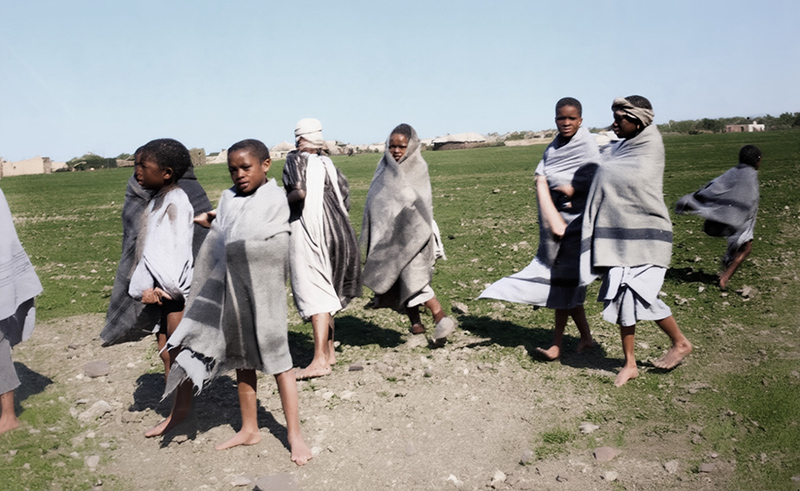
Although the prime target of the British concentration camp system during the Second Anglo-Boer War (1899–1901) was Boer civilians (with the successful intention of cutting off the Boer Commando supply system), the British also interned thousands of Africans in racially segregated camps at the same time. These Africans were either “agterryers” (“back riders”, or support servants to the Boer commandos) or were workers on the Boer farms that were destroyed during the British “scorched earth” campaign. These segregated Black camps were not rigidly policed as were the Boer camps, and the Africans were free to come and go as they pleased, or when they found work, often with the British Army. Due to the open nature of these Black camps, the exact number of detainees—and deaths in the camps—is unknown. Above, Africans in the Blacks-only Bronkhorstspruit concentration camp, Transvaal.
This led to the British authorities bringing in the Asiatic Registration Act of 1907, requiring the fingerprinted registration of all Indians and the creation of separate living areas for Indians. This was followed by the Transvaal Pass Law Ordinance 14 of 1907, which introduced fingerprinted “passes” for all Africans.
By 1910, when South Africa became a self-governing dominion, the country had inherited a coherent racial order: “pass” laws, segregated living spaces, racially stratified labor markets, and a color-based legal hierarchy. These British-era systems were in fact the foundation of what later became known as Apartheid.
Race Laws in British Africa, c. 1840s–1960s
In West Africa, the British colonial authorities implemented town-planning ordinances in the Gold Coast (1892, amended 1923 and 1945), Lagos (1917), and Sierra Leone (1948) that formally divided all urban areas into “European,” “mixed,” and “African” zones. The Crown Lands Ordinances in the Gold Coast (1897) and Lagos (1902) vested the most valuable coastal and commercial land in the Crown and leased it almost exclusively to Europeans or European firms. This was, of course, because they were the only such firms or individuals capable of creating enterprises on these lands.
The large-scale presence of Africans near many of the main British settlements also caused health hazards, due to the low living standards and insanitary conditions that they created. The Mosquito and Sanitation Ordinances in Lagos (1901) and Accra (1908) authorized the compulsory removal of Africans from central districts. At the same time, separate European-only wards in Nigerian hospitals were statutory until the 1950s.
The rampant abuse of alcohol among the Africans forced the colonial authorities to completely ban the sale of European spirits to Africans in the Northern Nigeria Proclamation No. 10 of 1902 and the Gold Coast Native Liquor Ordinance 1930.
The British colonial civil service maintained a rigid color bar: until the reforms of 1947–1953 no African could rise above the “Senior African” grade, and separate European and African salary scales persisted into the 1950s.
British colonial rule in East Africa exhibited the starkest statutory segregation. In Kenya, the Crown Lands Ordinances of 1902 and 1915 allocated the till-then unsettled White Highlands exclusively to European ownership and prohibited Africans from purchasing or leasing land there until 1960.
The kipande system, regulated by the Native Registration Ordinance 1915 and updated in 1920, compelled every employed African male to carry a fingerprint pass, while the 1918 Resident Native Labourers Ordinance criminalized desertion by African squatters on European farms.
In the capital city of Nairobi, municipal rules forbade Africans from residing or even walking on certain streets after 9 p.m. without a permit. This remained in place until the 1950s.
In addition, all schools in Kenya were strictly racially segregated, and the Nairobi European Hospital remained racially exclusive until independence.
BRITISH SETTLER LAND POLICY IN KENYA’S “WHITE HIGHLANDS”

A British settler and his workers in the Kenyan “White Highlands.” This was a region designated by the colonial administration in the early twentieth century as an exclusive European agricultural settlement zone, reserved through a series of ordinances beginning in 1902 that allowed extensive White settler farming on largely unoccupied land. The use of African labor undermined the White Highlands policy, and when violent African resistance erupted during the 1950s, the isolated farmers and their families quickly became victims of terrorist attacks that forced them off their lands. The White Highlands policy had been effectively abandoned by the time Kenya became independent in 1963.
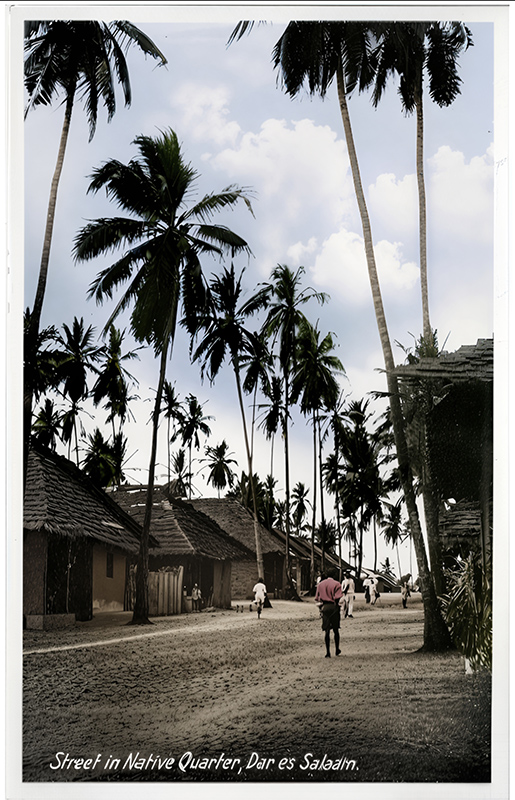
In the Uganda colony, the Buganda Land Settlement of 1900 and subsequent township ordinances of 1903 and 1930 created racially zoned residential areas in Kampala and reserved European “civil lines,” while in Tanganyika (under British mandate after 1919, today known as Tanzania), the 1920s Township Rules divided the capital city of Dar es Salaam and other towns into three residential zones: “European Zone I, Asian Zone II, and African Zone III.”
In Central Africa the pattern was repeated. In 1928, the first of a series of “Orders in Council” in Northern Rhodesia (today the country of Zambia) created racially separate residential areas, and on the large copper mines of the north of that country, a set of urban housing ordinances (1929–1954) and emergency regulations (1935) enforced racially segregated compounds and curfews.
BRITISH RESIDENTIAL SEGREGATION IN DAR ES-SALAAM
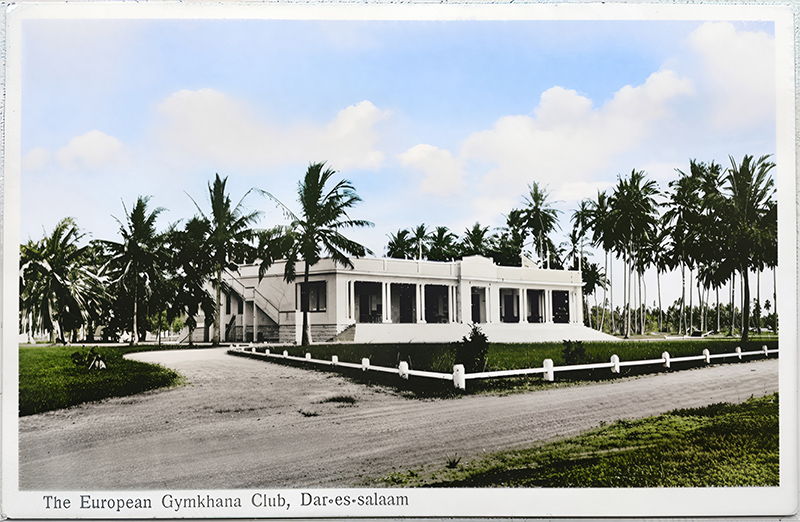
In the British colony of Tanganyika (the former German East Africa, and today the state of Tanzania), acquired as a League of Nations mandate at the end of the First World War, the colonial authorities instituted residential racial segregation. These two postcards, both from the 1920s, illustrate different aspects of the British system. Above, the European-only horse-riding club in Dar es-Salaam, and below, a street in the “native quarter” of the city. (Newman Art Publishing Co., Cape Town, and A.C. Gomes, Zanzibar.)
The colony of Southern Rhodesia, though self-governing from 1923, operated under ultimate British oversight until 1965, and enacted the Land Apportionment Act of 1930 with the approval of the Colonial Office. This law allocated half the country’s land to Europeans, while the Industrial Conciliation Act of 1934 excluded Africans from the definition of “employee,” thereby legalizing a color bar in skilled trades. The Native Registration Act of 1936 then introduced compulsory “passes” to be carried by all Africans in the White areas.
Race Laws in the British Empire’s “Thirteen Colonies,” North America
British North America south of the future Dominion of Canada comprised the Thirteen Colonies—which were to form the core of what became the United States of America—and the Floridas. In all of these territories the British Crown and colonial legislatures erected a comprehensive system of racial segregation directed primarily at Africans, and secondarily at Indians.
SLAVE-DRIVEN TOBACCO ECONOMY IS VIRGINIA’S LARGEST EXPORT
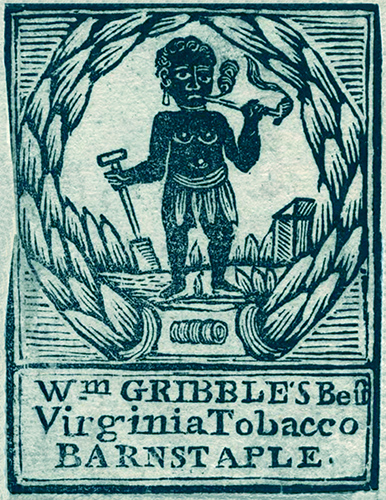
A circa 1670 tobacco wrapper, using an African slave as a marketing tool, issued by William Gribble, a tobacconist and retail shopkeeper based in Barnstaple, Devon, England. Beginning in the 1660s, the Virginia General Assembly enacted a series of laws designed to maintain racial segregation from that colony’s growing numbers of African slaves, including a 1691 law criminalizing sexual relations between Whites and Blacks. Laws enacted after 1700 included those prohibiting slaves from owning property, carrying weapons, traveling without written passes, assembling in groups, or learning to read and write. “Free Negroes” and mulattoes faced separate restrictions, including bans on holding public office, voting, serving on juries, or testifying against Whites in court. Residential and occupational segregation was enforced through plantation layouts that confined enslaved workers to remote quarters, while laws required White overseers and mandated racial ratios on estates. After 1723, “Free Negroes” were subjected to special taxes, prohibited from employing White servants, and required to register annually or risk re-enslavement.
The foundational legal architecture was slavery itself, which every colony codified between the 1660s and 1700s. The colony of Virginia’s 1662 statute declared that children followed the condition of the mother (partus sequitur ventrem), and its 1705 “An act concerning Servants and Slaves” gathered all the previous disparate and localized rules into a comprehensive code that declared that “all servants imported… who were not Christians in their native country… shall be accounted and be slaves,” and it made the status of slavery heritable through the mother.[9] The same act barred all slaves from bearing arms without a written pass; established special courts for slave offenses; and outlawed racial intermarriage completely.[10]
In addition, the 1705 law added that “no individuals, such as Negroes, mulattos, Indians, Jews, Moors, Muslims, or other non-Christians, will be allowed to purchase Christian servants. If any person from the aforementioned groups purchases a Christian white servant, that servant will automatically become free.”[11]
By 1750 every southern and middle-colony legislature had enacted similar comprehensive slave codes that segregated public space.
The colony of South Carolina’s 1740 “Act for the better Ordering and Governing Negroes and other Slaves in this Province,” often called the Negro Act, similarly formalized segregation. Passed in the aftermath of a Negro uprising known as the “Stono Rebellion,” it declared that “all negroes, Indians, mulattoes and mestizoes… shall be and are hereby declared to be and remain for ever hereafter absolute slaves” and “chattels personal in the hands of their owners.”[12] The law also forbade slaves from traveling, assembling, growing their own food, earning money, or learning to read and write without explicit permission.[13]
Finally, interracial marriage and sexual relations were prohibited everywhere in the British colonies. For example, Virginia’s 1691 act banished any White who married a “negro or mulatto.”[14]
British colonial policy dealing with the Indians was equally strict. The Virginia General Assembly, when ratifying the treaty ending the Third Anglo-Powhatan War of October 1646, fixed Indian “habitation and places of aboade” within defined bounds and forbade them from entering English settlements except at authorized “English houses” under heavy restrictions. The treaty required that “no Indian shall come to any English plantation” without a badge showing they were “a friend” and limited where they might hunt and fish, on pain of being treated as enemies.[15]
In 1692, the Massachusetts provincial legislature passed “An Act for the better Rule and Government of the Indians in their several Places and Plantations,” which placed Indians under the jurisdiction of justices of the peace and selectmen, empowered colonial officers to appoint “guardians” and local overseers, and prescribed how Indian complaints, disputes, and minor crimes would be heard in colonial courts.[16]
EARLY ALCOHOL CONTROLS ON INDIANS IMPOSED BY THE BRITISH
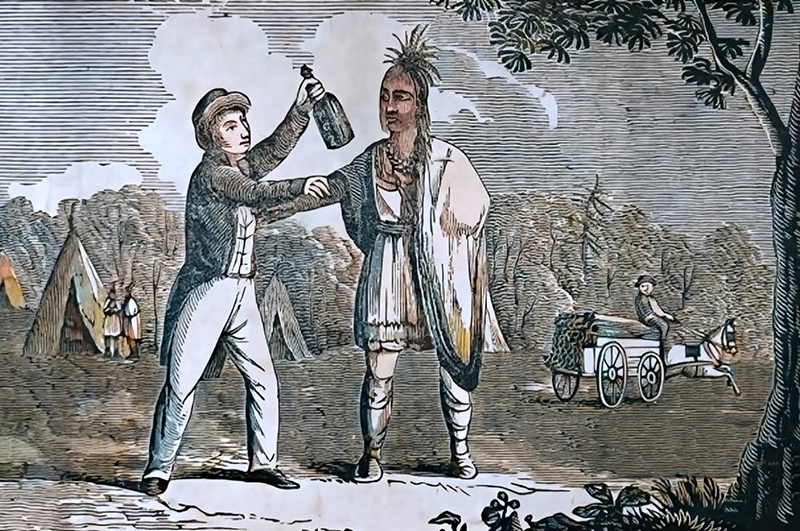
The rampant abuse of alcohol among American Indians caused the British colonial authorities to place restrictions upon the availability of intoxicating substances to that race. These measures were implemented in an effort to control alcoholism among Indians and also to prevent unscrupulous White traders from exploiting the Indians. Above, an illustration from an 1835 book, captioned “Manner of Instructing the Indian.” (William Apess, Indian Nullification of the Unconstitutional Laws of Massachusetts Relative to the Marshpee Tribe; or, The Pretended Riot Explained. Boston: Press of Jonathan Howe, No. 39 Merchants Row, 1835.)
During Queen Anne’s War the General Court also enacted “An Act to Encourage the Prosecution of the Indian Enemy and Rebels,” which set monetary rewards for killing or capturing Indians. The text provides “for every man or woman of the said enemy that shall be by them slain, the sum of fifty pounds; and for every child of the said enemy… the sum of ten pounds,” with funds reserved “towards answering of the rewards granted by the act of this court, as encouragement to the prosecution of the Indian enemy.”[17]
Early Connecticut law repeatedly singled out Indians for weapons prohibitions. A 1640s order in The Public Records of the Colony of Connecticut forbade colonists to “sell or give” guns, powder, shot, lead, or similar arms to any Indians, on penalty of fines and confiscation.[18] Later entries from the 1650s and 1660s extended this further, requiring licenses for any limited trading of arms, authorizing searches, and permitting confiscation of weapons found in Indian hands contrary to law. One mid-century statute ordered that “if any Indians shall bring in Guns into any of the Towns,” they could be seized, and the owners punished.[19]
The Records of the Colony of Rhode Island and Providence Plantations imposed fines “for selling liquor to Indians,” establishing penalties for colonists who provided wine or strong drink to them, all in an attempt to curb the almost completely widespread alcohol addiction amongst Indians.[20]
This rule was duplicated in New Hampshire, when in 1724 the provincial legislature authorized payments for “Indian scalps,” establishing a bounty of £100 for every adult male Indian scalp turned in, with lesser sums for women and children.[21] Similar regulations were made in other states, including Pennsylvania and Maryland as well.
Also in Maryland, a 1650 act forbade “English or other Christian” subjects from selling guns, powder, or shot to “any Indian whatsoever,” on pain of fines and imprisonment, while allowing limited licensed trade in such goods under close government supervision.[22]
Another act of 1741 specified a fine of £50 for the “marriage of any white man or woman with an Indian, negro, mustee, mulatto, or any person of mixed blood to the third generation, bond or free.” Any minister or justice of the peace performing such a service was also to be punished by a fine of £50.[23]In 1692, the colony of Maryland passed an act against the marriage or “promiscuous sexual relations of whites and negroes or other slaves.” A White person found guilty would be sentenced to become a “servant” for seven years.[24]
A Massachusetts act of 1705 forbade interracial marriage in this way: “…none of her majesty’s English or Scottish subjects, nor of any other Christian nation within this province, shall contract matrimony with any negro or molatto; nor shall any person duely authorized to solemnize marriages presume to joyn any such in marriage, on pain of forfeiting the sum of fifty pounds…”[25]
In 1714, the Virginia colony enacted the “Act for the Better Regulation of the Indian Trade,” which allowed the authorities to revoke the trading license of any colonist who violated rules regarding prices, the provision of arms, and conduct toward Indians.[26] Trade in guns and ammunition with the Indians was also outlawed in South Carolina’s 1721 “Act for the better Regulation of the Indian Trade,” upon punishment of the seizure of any unlicensed trader’s goods.[27]
Race Laws in the British Caribbean Colonies
The most influential early model of racial segregation in the British Empire’s western hemisphere colonies was in fact the Barbados Slave Code of 1661, “An Act for the better ordering and governing of Negroes,” upon which many of the continental North American codes were based. This act defined African slaves as chattel property, inheritable through the maternal line, and described Negroes as “an heathenish brutish & an unsertain dangerous kind of people…”[28]The act also barred slaves from joining the militia (an attempt to prevent the Africans from acquiring arms or the skills to use them), and in Caribbean towns such as Bridgetown, Barbados, and Port Royal, Jamaica, “Free Negroes” were excluded from certain guilds, militias, and civic offices, and separate residential areas were created.
BRITISH CARIBBEAN SLAVE SOCIETY STRICTLY SEGREGATED
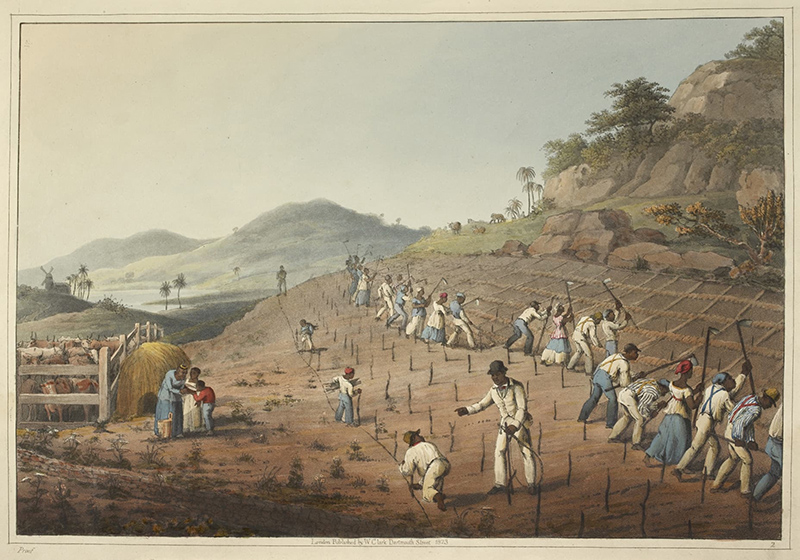
African slaves laboring on a sugar plantation in the British colony of Antigua, circa 1820s. In Antigua, as in other British Caribbean colonies, racial segregation and control were enforced through a comprehensive slave code regime. The Antigua Slave Act of 1702 and subsequent consolidations prohibited slaves from leaving plantations without written passes, barred them from carrying weapons, and restricted their assembly after dark. (Ten Views in the Island of Antigua, William Clark, London: Thomas Clay, 1823.)
In Barbados, a law was enacted that barred Jews (mostly Sephardic Jews who had entered the Western Hemisphere with the Portuguese) from owning slaves. The reason for this was fear of subversion: records from the Barbados Council and Assembly show that the settlers were convinced that the Jews were forming alliances with the Negroes to subvert the authorities.
A 1688 Order of the Barbados Council restricted Jews from “keeping Negroes in hired service in the town,” explaining that such employment “introduceth familiarity between Jews and Negroes not consistent with the security of this Government.”[29]
In 1679, the Barbados Assembly warned that Jews “keep Negroes in their shops and employ them in sundry errands and dealings, to the prejudice of His Majesty’s subjects and the safety of this island” and that such contact may “corrupt the Negroes and give occasion to dangerous intelligence.”[30]
As a result, when the Barbados Assembly reenacted the slave code, with minor modifications, as “A Supplemental Act to a Former Act for the Better Ordering and Governing of Negroes,” 1682, and in 1688 titled as “An Act for the Governing of Negroes,” Jews were singled out as not being allowed to own slaves: “No person of the Hebrew Nation residing in any Sea-Port Town of this Island, shall keep or employ any Negro or other Slave … for any Use or Service whatsoever.”[31]
Jamaica’s Consolidated Slave Act of 1792 required tickets for any slave leaving a plantation and created segregated “Free Negro” towns under White supervision.[32]
Finally, interracial marriage and sexual relations were also completely outlawed in all the British Caribbean colonies.
Race Laws in British South America
The British Empire’s permanent South American possessions were confined to the three counties of Essequibo, Demerara, and Berbice, which were ceded by the Netherlands in 1814–15 and amalgamated as British Guiana in 1831. British Guiana went on to develop one of the Empire’s most complete systems of racial segregation outside of British South Africa: slavery-era codes, post-emancipation indenture laws, residential zoning, segregated education, hospitals, transport, clubs, and prisons.
The first major law introduced by the British was the Slave Registry Ordinance and the Consolidated Slave Act of 1826. This codified separate legal personality for Whites and nonwhites, prohibited slaves from giving evidence against Whites, imposed curfews, banned slave assemblies except for Christian worship, and required written passes for any movement off the plantations.
Residential segregation was rigid. Plantations were zoned with the “great house” and White staff quarters physically separated from the slave village or “negro yard,” often by a considerable distance and sometimes by fences or ditches. In Georgetown, the capital, the 1810 Town Superintendent’s regulations confined “Free Coloured” and “Free Negro” housing to the southern suburbs, while the northern promontory and Cummingsburg remained almost exclusively White until the 1840s.
RACIAL SEGREGATION IN BRITISH-COLONIAL BARBADOS
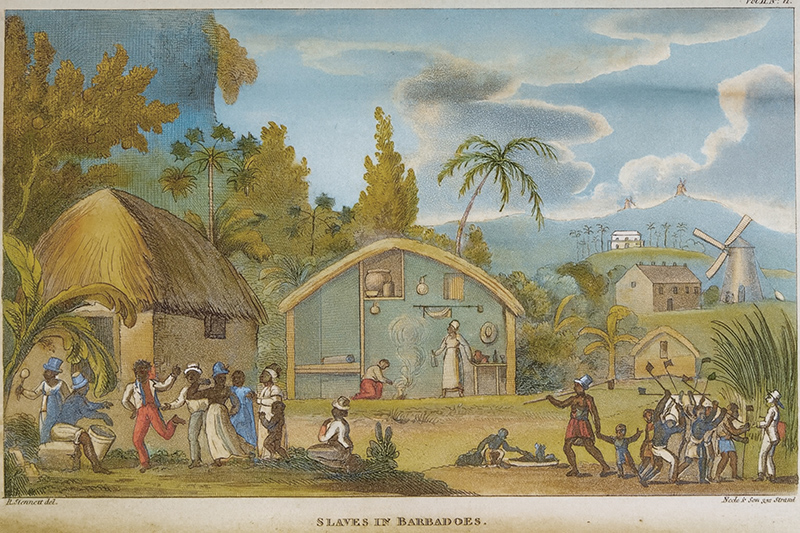
An early 1800s engraving depicting the daily lives of African slaves in Barbados, set against a backdrop of strict racial segregation enforced by British colonial law. The Africans lived, worked, and gathered in spaces deliberately kept separate from the white planter class, whose authority was reinforced through a detailed legal code. Barbados’ slave laws included restrictions on movement, assembly, and statutes criminalizing sexual relations between the races. (From the engraving Slaves in Barbadoes, circa 1818, National Maritime Museum, Greenwich, London.)
Post-emancipation indentured immigration from India (1838–1917) and later Madeira, China, and West Africa produced a new, tripartite segregation. The Immigration Ordinance of 1854 and subsequent amendments legally bound Indian indentured laborers to five-year industrial residence on specific estates, enforced by criminal sanctions for absence and by a pass system almost identical to that of slavery.
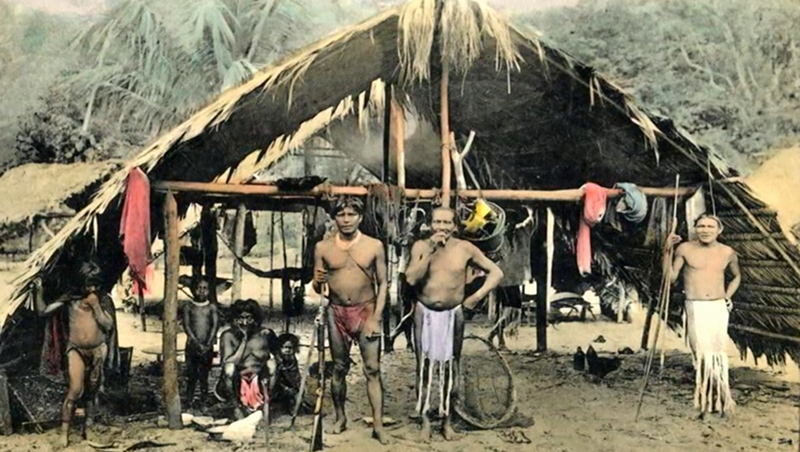
Housing on sugar estates remained segregated: ex-African “creole” workers in the old negro yards, Indians in bounded “logies” or range houses, and Portuguese or White staff in separate compounds. In Georgetown and New Amsterdam, municipal ordinances of the 1890s–1920s prohibited Indian residence in central wards, creating what became known as the “bound coolie” districts.
Education was segregated by law and finance. The 1876 Compulsory Education Ordinance and subsequent acts maintained dual systems: elite secondary schools (Queen’s College, founded 1844) remained virtually all-White until the 1940s, while primary education was racially zoned by village and estate.
GEORGETOWN, BRITISH GUIANA: A TALE OF TWO CITIES
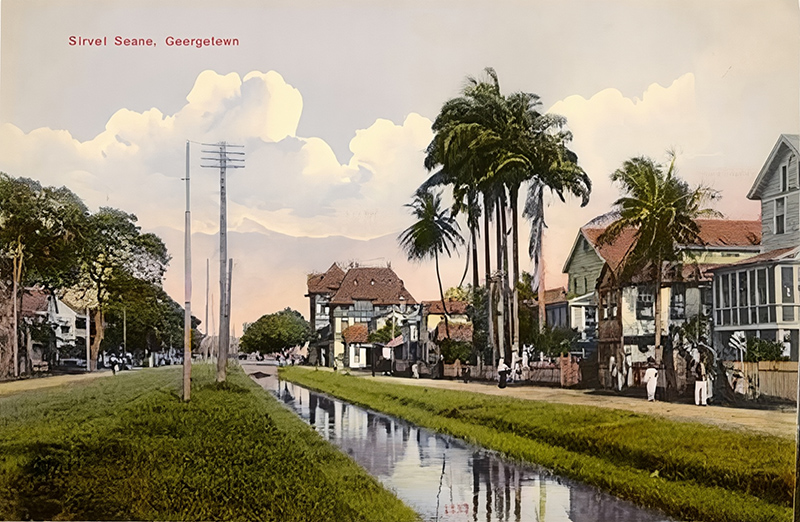
These two hand-colored postcards from the early 20th century, issued in Georgetown, British Guiana, reveal the extent of the racial divide in that colony. Above, a main street in the “White town” of the city, and below, an Indian dwelling on the outskirts of the town. The Indians—and the former slaves—were prohibited by law from acquiring residences in the town.
Public facilities were segregated by ordinance. The Georgetown Hospital maintained separate African, Indian, and European wards until the 1950s, while the cinemas, cricket clubs (Georgetown Cricket Club until 1956), and the Georgetown Club excluded nonwhites by rule. The 1893 Prison Ordinance formalized separate cell blocks by race, broken down into “African, Indian, European/Chinese.”
The Crown Lands Regulations of 1849 and 1898 reserved the coastal sugar belt for large estates while confining African and later Indian villages to the interior or to purchased abandoned plantations, creating what was known as the “coastlander” vs. “interior” racial geography of the colony.
Race Laws in British Australia, 1788–1901
From the establishment of the penal settlement at Sydney Cove in 1788 until the achievement of responsible self-government across the six colonies and the creation of the Commonwealth of Australia in 1901, the British colonial state and its successor Australian legislatures under imperial oversight created a comprehensive system of racial segregation directed primarily at Aborigines and Torres Strait Islanders, Chinese, Pacific Islander, and other non-European migrants.
By the 1850s, every colony had enacted legislation authorizing the creation of Aboriginal reserves and missions on which residence was compulsory for most of that race: the Victorian Aboriginal Protection Act 1869 and its Queensland counterpart of 1897 granted Protectors sweeping powers to remove Aborigines to these reserves and to control all movement by pass or permit.
Residential segregation was absolute in towns and cities. Sydney’s 1816 and 1836 proclamations banned Aborigines within the town boundaries after dark; Melbourne’s 1840 municipal regulations confined Aborigines to the western bank of the Yarra after sunset; Brisbane’s 1850 police ordinances forbade Aborigine residence within the city limits. From the earliest days of the colony until the grant of responsible government in the 1850s, British colonial authorities in Australia regarded alcohol as one of the most devastating influences on Aborigines and attempted to suppress its supply through a succession of increasingly stringent prohibitions.
As early as 1804 Governor Philip King (1758–1808) forbade the sale or gift of spirits to Aborigines. In 1838 New South Wales enacted the first colony-wide statute that made it an offense anywhere in the colony to sell, barter, or give alcohol to any Aborigine, with penalties ranging from heavy fines to imprisonment with hard labor. Similar total prohibitions were introduced in Western Australia in 1843, in South Australia in 1844, and in the newly separated colony of Victoria in 1850, each backed by fines, jail terms, or loss of publican’s license for offenders.
AUSTRALIAN ABORIGINAL PRISONERS IN SEGREGATED PRISON, 1883
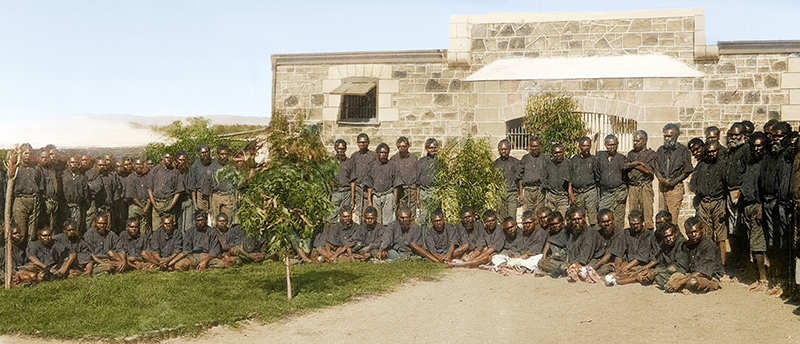
A photograph depicting a group of Aboriginal men detained on Rottnest Island, located off the northwest coast of Australia, in 1883. The prison was for individuals convicted of serious offenses such as robbery, murder, and other major crimes, with its remote island location used to enforce isolation. The British colonial authorities maintained racially segregated prisons, residential areas, and public facilities in their Australian colonies. (State Library of Western Australia.)
In Queensland and Western Australia, the 1897–1901 Aboriginals Protection Acts explicitly authorized the forced removal of Aboriginal workers to government stations or missions if employers complained. Chinese residents were confined to segregated quarters in Melbourne, Sydney, and most goldfields towns by municipal ordinance: the Victoria Chinese Immigration Act 1855 limited the number of Chinese passengers on any ship to one per ten tons of cargo and imposed a poll tax on Chinese arrivals. A similar 1861 law in New South Wales imposed nearly identical rules.
Pacific Islander laborers in Queensland were segregated on plantations under the Polynesian Labourers Act 1868 and its successors, and then were forcibly deported under the Pacific Island Labourers Act 1901. These colonial measures laid the groundwork for the White Australia Policy after Federation—most notably the Immigration Restriction Act 1901, which used a dictation test to exclude non-European migrants.
Race Laws in British New Zealand, 1840–1907
Although New Zealand never enacted a comprehensive statutory code of racial segregation, residential segregation in towns was enforced administratively and by private covenant. Auckland’s 1841–42 land sales reserved the central ridge for European purchasers while Māoris were granted small suburban sections at Mechanics Bay and Ōrākei. Private real estate covenants in Dunedin, Nelson, and suburban Auckland from the 1880s routinely prohibited sale or lease to “Maoris, Chinese, or Hindus” until declared unenforceable in the 1960s.
The New Zealand Constitution Act 1852 created a parliament using a franchise based on males who held individual property titles. Because most Māori land remained communally held, Māori men were effectively excluded from voting. In response to this the Māori Representation Act 1867 was passed, which created four dedicated Māori electorates and granted all Māori men aged 21 and over the right to vote in them. This system has been kept in place to the present day, and there were, as of 2025, seven dedicated Māori-only seats in the New Zealand parliament.
The 1867 Native Schools Act established a separate system of village schools under the Native Department. Even though there was no specific law segregating other public schools, in practice, lower educational achievements saw the few Māori pupils enrolled in those schools relegated to separate classrooms, with the 1877 Education Act’s “conscience clause” specifically allowing for such differentiation.
MĀORI “NATIVE SCHOOL,” 1908
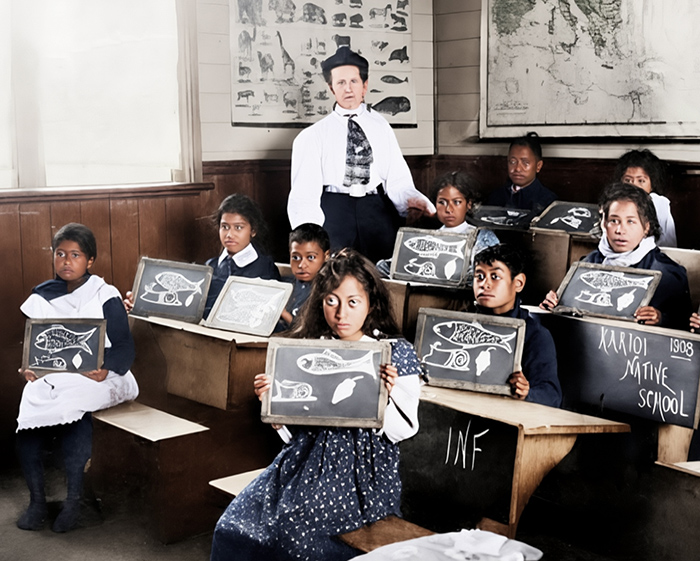
A class photo of the “Karioi Native School,” New Zealand. British colonial authorities ordered the establishment of “native schools” and made attendance compulsory. These segregated schools were the Māoris’ first experience of formal education.
Alcohol distribution to Māoris was strictly controlled, due to rampant and nearly universal abuse in that community. The Licensing Act of 1881 and subsequent statutes banned the sale of alcohol to the Māoris until 1948. Hospitals maintained separate Māori wards until the 1950s, while public facilities such as swimming baths and barber shops in provincial towns routinely displayed “Europeans only” signs until the 1960s.
Military and police segregation was pronounced during the New Zealand Wars (1845–1872), with those Māori who remained loyal to the authorities fighting in separate kūpapa units under their own chiefs. The Armed Constabulary and later police maintained separate Māori constables for Native districts until the 1920s.
Race Laws in British North America (Canada)
British North America—the colony which eventually became Canada—was partitioned on racial grounds by the British colonial authorities in 1763, when a Royal Proclamation of 1763 reserved all lands west of the Appalachian watershed for the Indian tribes and prohibited private purchase by Whites. The proclamation drew a line along the Appalachian watershed and declared the vast interior west of the established colonies “Indian Territories,” where Indians “should not be molested or disturbed” by settlers and where only the Crown could purchase land through public treaties.[33]
From the 1830s, British North American legislatures, with imperial approval, intensified this reserve system. The Crown Lands Protection Act of 1839 in Upper Canada declared that Indian reserve lands would be treated as Crown lands. This made the colonial government the legal guardian of reserves and barred the Indians from freely selling or mortgaging their own land to Whites—a move designed to protect them.
When several thousand Negroes—mostly Loyalist slaves brought by their owners, and a number of “free Negroes”—arrived in Canada after the American Revolution, Nova Scotia Governor John Wentworth (1737–1820) granted land to them, ensuring that they were physically and geographically separated from White settlements.
In 1801, an Upper Canada statute limited Black immigration by requiring certificates of freedom and sureties, and in 1849 the Upper Canada School Act permitted separate schools “when parents desired it,” which in practice meant racially segregated schooling in Hamilton, Chatham, Amherstburg, and Sandwich until the 1890s.
Military segregation was absolute: Blacks who enlisted in the British North American forces during the 1812 war served in segregated companies (the “Coloured Corps” in Upper Canada, the “Black Pioneers” in Nova Scotia) and were discharged to segregated land grants.
“White Supremacy” and the “Civilizing Mission”
The primary practical reason for the difference in approach was that the British Empire could draw upon a larger mobile, home White population—soldiers, administrators, and settlers—who could be dispatched in sufficient numbers to majority occupy the colonies in North America, and in other regions, in large enough numbers to make up communities by themselves.
The Iberian Empires, in contrast, all failed to send large numbers of White female settlers and colonists. This in turn inevitably led to racial miscegenation in their colonies.
However, there was another philosophical reason underpinning the British Empire: a sense of “White Supremacy” and its accompanying paternalism towards the nonwhite races of the world. This paternalism took the form of a sense of “moral obligation” to “civilize” these other races.
This approach was best summed up by the British colonial administration in Canada, and specifically the 1842–44 Bagot Commission, the 1857 Gradual Civilization Act, and the Indian Act of 1876.
The Bagot Commission was a royal commission established by Governor General Charles Bagot (1781–1843) with the stated aim of “civilizing” the Indians, or, as the report said: “…gradually reclaiming them from a state of barbarism, and of introducing amongst them the industrious and peaceful habits of civilized life.”[34]
This was followed by a law whose title, perhaps more than anything else, sums up the underlying idea behind the British “mission”—The Gradual Civilization Act of 1857 (formally, “An Act to Encourage the Gradual Civilization of the Indian Tribes in this Province”).
This law created a legal mechanism for enfranchisement, by which an Indian man could renounce “Indian status,” leave his band (tribe), and become an ordinary British subject with all the rights of any other male citizen, including the right to vote and own property individually.
The Act and its regulations required that an Indian be at least 21 years of age, be able to speak, read, and write either English or French “with ease”; be of good moral character (as certified by local non-Indian witnesses, usually a clergyman, magistrate, or other “respectable” settler); be free from debt (or have made satisfactory arrangements for any debts); and be sufficiently educated to be capable of managing his own affairs.
The Act explicitly required a minimum level of education equivalent to that of the average White settler.
In practice this was examined by a special board of three examiners (usually a local magistrate, a missionary, and another official) who tested the applicant’s reading and writing ability, basic arithmetic, and general knowledge (often including British history and Christian doctrine). The absurdity of this policy is evident from the fact that only one Indian was ever successfully enfranchised under this act, a certain Dr. Oronhyatekha in the 1860s. As a result, this law was replaced in 1869 by the Gradual Enfranchisement Act, which kept the same rigorous literacy, education, and character tests, causing no change in the overall status of the Indians.
The failure of all these efforts to “civilize” the Indians then led to the Indian Act of 1876 (and its later amendments).
In terms of this law, Indians were denied the right to vote in federal elections (a status which remained in place until 1960), and tribal governance was tightly controlled by the federal government through the system of Indian Agents, who could overrule band councils and regulate virtually all community decisions.
The Act also defined who legally counted as an “Indian,” and included clauses which ruled that Indian women lost their tribal status if they married “non-status” men—a rule that did not apply to men and that remained in place until 1985.
Although not explicitly written into the Act, the federal government used its powers under it to enforce a “pass” system from the 1880s to the 1940s, requiring Indians to obtain written permission from an Indian Agent to leave their reserves.
At the same time, the Indian Act still attempted to suppress Indian “spiritual practices” in an attempt to promote assimilation. In this way, the Indian ceremonies of “Potlach” (an initiation rite) and the “Sun Dance” (in which Indian participants would pierce their chest or back muscles with skewers attached to ropes tied to a pole and dance until the skewers tore free, a ritual of self-harm) were banned in 1884. These bans remained in place until the mid-20th century.
The Indian Act also created a residential school system, under which Indian children were removed from their parents’ control and placed in boarding schools in an unsuccessful attempt to break cultural patterns from being passed down.
Failure of “White Supremacy”
All these measures—in Canada and elsewhere—were ultimately a failure, and represent the ultimate futility of the “White Supremacy” mission which underpinned the British Empire. This was because no matter how many benefits White rule provided, the ruled nonwhites never accepted White domination as a suitable trade off for these benefits, and always agitated against their benefactors.
“FROM THE CAPE TO CAIRO”: BRITISH EMPIRE’S CIVILIZING MISSION AGAINST BARBARISM
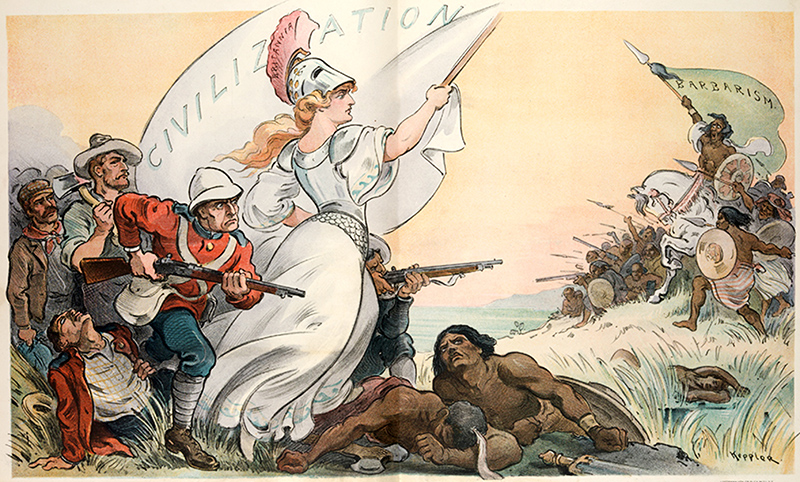
A cartoon from the British magazine Puck from 1902, titled From the Cape to Cairo, depicts a European goddess, backed by British and colonial forces, carrying the flag of “Civilization” up a hill against the nonwhite forces of “Barbarism.” It accurately reflects the then prevalent belief during the era of New Imperialism that it was the duty of White nations to civilize and uplift nonwhites. (Puck, vol. 52, no. 1345, December 10, 1902.)
[1] Winston S. Churchill, My Early Life, p. 89, London: Thornton Butterworth, 1930.
[2] Bengal Club Circular, 1880, Bengal Club Archives, Kolkata.
[3] Bombay Sanitary Report, 1867, Bombay Presidency.
[4] Letter to the Secretary of State for India, 1874, in The Collected Letters of Florence Nightingale, ed. Lynn McDonald, vol. 14, p. 87, Waterloo: Wilfrid Laurier University Press, 2012.
[5] Punjab Military Handbook, page 47, Lahore: Punjab Government Press, 1895.
[6] Cape Colony, Proclamation No. 50 (1809), in Cape of Good Hope Government Gazette, 1809.
[7] Letter to the Colonial Office, John Cradock, 1811, CO 48/41, UK National Archives.
[8] Natal Colonial Office Records, Shepstone Correspondence, 1846, Pietermaritzburg Archives.
[9] William Waller Hening, ed., The Statutes at Large; Being a Collection of All the Laws of Virginia from the First Session of the Legislature, in the Year 1619, Philadelphia: R. & W. & G. Bartow, 1823, 3:447–463.
[10] Ibid., clauses XIX and XX.
[11] Ibid., clause XI.
[12] Grimké, J. F., The Public Laws of the State of South-Carolina, from Its First Establishment as a British Province Down to the Year 1790, Inclusive, R. Aitkin & Sons, Philadelphia, 1790.
[13] Ibid.
[14] The Statutes at Large; Being a Collection of All the Laws of Virginia, Hening, William Waller, New York, 1819.
[15] Hening, op. cit.,1:323–326.
[16] Acts and Laws, of His Majesties Province of the Massachusetts-Bay, in New-England, Boston, Bartholomew Green and John Allen, 1699.
[17] The Acts and Resolves of the Province of Massachusetts Bay, Vol. I, 1692–1714, p. 292, Boston, Wright & Potter, printers to the state, 1869.
[18] “Capitall Lawes established by the Generall Court, the first of December, 1642,” The Public Records of the Colony of Connecticut, Prior to the Union with New Haven Colony, May, 1665, ed. J. Hammond Trumbull, vol. 1, p. 79, Hartford: Brown & Parsons, 1850.
[19] Ibid.
[20] The General Laws and Liberties of the Massachusetts Colony: Revised & Published, By Order of the General Court in October 1658, volume 74, 1672.
[21] A Summary, Historical and Political, of the First Planting, Progressive Improvements, and Present State of the British Settlements in North-America, William Douglass, Vol. I, 1749–52, R. & J. Dodsley, Pall Mall, London, 1760.
[22] Indian Slavery in Colonial Times within the Present Limits of the United States, Almon Wheeler Lauber, Columbia University, New York, 1913.
[23] The Public Acts of the General Assembly of North Carolina, James Iredell, Volume I, pp. 45–46, Newbern: Martin & Ogden, 1804,
[24] Economic and Social History of New England, 1620–1789, Volume I, p. 403, Houghton Mifflin Company, Boston and New York, 1890.
[25] The Acts and Resolves, Public and Private, of the Province of the Massachusetts Bay, vol. 1, pp. 578–79, Boston: Wright & Potter, 1869.
[26] Murray G. Lawson, “An Act for the Better Regulation of the Indian Trade, 1714,” Virginia Magazine of History and Biography 55, no. 4, October 1947, pp. 329–32, Virginia Historical Society, Richmond.
[27] The Statutes at Large of South Carolina, Thomas Cooper, Volume 3, A. S. Johnston, Columbia, S.C., 1838,
[28] The National Archives, UK, CO 30/2, opening paragraph.
[29] Minutes of the Council of Barbados, 18 April 1688, printed in: Calendar of State Papers, Colonial Series, Vol. 13: 1688–1689, p. 72, London: HMSO, 1891.
[30] Journal of the Barbados Assembly, 12 March 1679. Transcribed in: Harlow, Vincent T., & P. F. Stevens, eds., A History of Barbados: From Amerindians to Caricom, pp. 126–127, London: Frank Cass, 1976.
[31] The Laws of Barbados Collected in One Volume by William Rawlin of the Middle Temple, London, Esquire, and now clerk of the Assembly of the said island, London: Printed for William Rawlin, 1699.
[32] An act to repeal several acts and clauses of acts respecting slaves, Edwards, Bryan, The History, Civil and Commercial, of the British Colonies in the West Indies, Vol. 2, 3rd ed., pp. 188–225, John Stockdale, Piccadilly, London, 1801.
[33] Royal Proclamation of 1763, Library and Archives Canada, Ottawa, Ontario.
[34] Report on the Affairs of the Indians in Canada. Laid before the Legislative Assembly, 20 March 1845. In Journals of the Legislative Assembly of the Province of Canada, 3rd Parliament, 2nd Session (1844–45), Appendix E.E.E., p. 15, Section I.