Description
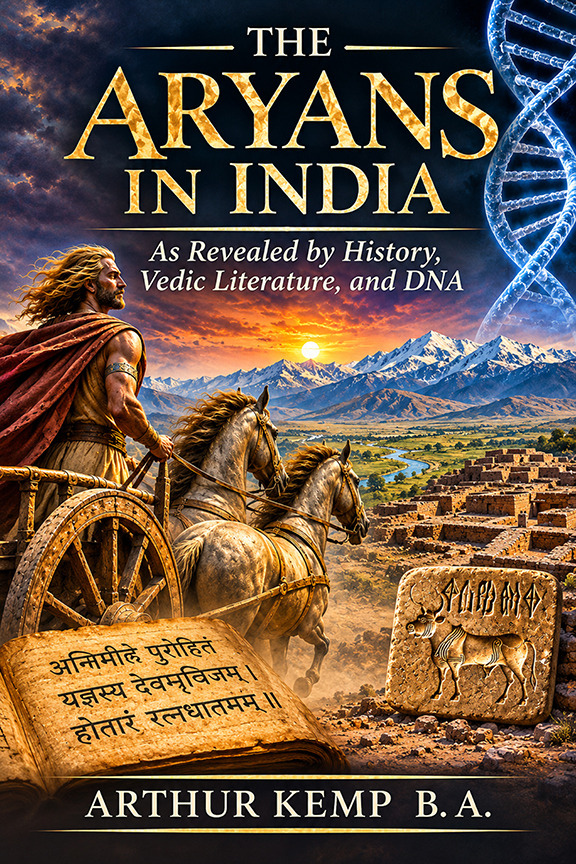
The Aryans in India: As Revealed by History, Vedic Literature, and DNA. By Arthur Kemp, B.A. There are few topics that have provoked more controversy and debate than the “Aryan Migration” of India.
This theory—first postulated when the similarities between Sanskrit and other European languages were detected by European scholars—states that from around the year 2000 BC, white-skinned Indo-Europeans, calling themselves “Aryans,” moved into northern India, defeated the already-established locals in battle, and established the basis of what later became Hindu civilization, and, as racial miscegenation proceeded, developed into the caste system, which still divides India by skin color.
The Aryan Invasion Theory formed a critical part of early 20th-century racial theory in Europe, but, after World War II and a rise in Indian nationalism—which claimed the Aryans as their own—the theory was dismissed and largely ignored.
Now, however, the science of genetics has firmly established the truth: the Aryan invasion happened, almost exactly as claimed by the original scholars.
This extensively researched book provides the full story:
- How the early European explorers noted the vast range of racial differences among the Indian population in the pre-colonial and colonial eras;
- How their scholars noticed and assembled the linguistic evidence based on their study of the ancient Indo-Aryan Sanskrit language;
- How the Vedic texts provided an understanding of how the varna (“caste”) system was developed and operated; and
- Finally, it provides a review of the very latest scientific DNA analysis, which has conclusively proven the Aryan Migration Theory as undeniable fact.
284 pages, softcover
Contents
Part I: The Discovery of the Aryan Question
Chapter 1: Europe Discovers India
Chapter 2: A Land of Many Faces
Duarte Barbosa, 1518—Jan Huyghen van Linschoten, 1596—Pietro della Valle, 1623–1624—Jean-Baptiste Tavernier, 1676—François Bernier, 1679—Balthazar Solvyns, 1799—James Baillie Fraser, 1815—Abbé Jean-Antoine Dubois, 1816—Anne Katharine Curteis Elwood, 1830—Physical Differences Noted
Chapter 3: The Invisible Walls of Caste
Caste, Varna, and Jati: Three Different Terms—Fourfold Division First Described—What the Hierarchy Meant in Everyday Life—The “Untouchables”—Physical Diversity in India—A Hierarchy with a Long History
Chapter 4: Europe’s First Encounters with Sanskrit
Sanskrit Before the Europeans—Filippo Sassetti: The First Recognized Similarities—Missionaries and the Study of Sanskrit—Sanskrit Enters British Scholarship—From Similar Words to a Common Ancestral Language—Why Sanskrit Was So Important
Chapter 5: The Speech That Changed Linguistics
William Jones: Scholar, Linguist, and Judge—The Foundation of the Asiatick Society, 1784—Calcutta, February 2, 1786: The Third Anniversary Discourse—The Passage That Changed Linguistic History—What Jones Actually Discovered—The Reception and Influence of the Discourse
Chapter 6: Reconstructing a Lost Language
Friedrich Schlegel and the Importance of Sanskrit—Franz Bopp and the Comparative Study of Grammar—Rasmus Rask and the Discovery of Regular Sound Changes—Jacob Grimm and the Laws of Sound Change—August Schleicher: the Reconstruction of Proto-Indo-European—How a Lost Language Can Be Reconstructed—Later Philologists and the Refinement of the Method—The Indo-European Family Tree—The Special Relationship Between Sanskrit and Iranian—The Meaning of Arya in India and Iran—Reconstructing Proto-Indo-Iranian—What Language Reveals About Ancient Migrations
Chapter 7: The Birth of the Aryan Invasion Theory
Common Language to a Common Homeland—The Search for an Original Homeland—Christian Lassen and the Interpretation of Indian History—Max Müller and the Dating of the Vedic Age—Max Müller and the Meaning of Arya—The Vedic Evidence: Aryas, Dasas, and Dasyus—Other Scholars and the Development of the Conquest Narrative—From Linguistic Classification to Racial Theory—The Aryan Invasion Theory and the Caste System—The Discovery of the Dravidian Language Family—From Invasion to Migration
Part II: The Testimony of the Ancient Texts
Chapter 8: Gods Across Continents
Indra and the Thunder Gods of Europe—Indra’s Thunderbolt and the Vedic Conflicts—The Serpent-Slaying God—The Indo-Iranian Religious Connection—Mitra and Mithra: A Shared Divine Name—Soma and Haoma: The Sacred Ritual Drink—Shared Concepts of Truth and Divine Order—Arya and Airya: A Shared Designation—The Behistun Inscription—Darius at Naqsh-e Rostam: “An Aryan, Having Aryan Lineage”—Airyanem Vaejah: The Homeland of the Aryans—Aria, Ariana, and the Name Iran—Aria in the Writings of Strabo—Aria in the Geography of Ptolemy—The Mitanni Kingdom: Indo-Aryan Gods Outside India—The Treaty of Suppiluliuma and Shattiwaza—Kikkuli and the Horse-Training Texts—What the Mitanni Evidence Establishes
Chapter 9: Aryans and Caste in the Rigveda
The Daysus: Enemies of the Aryans—Indra and the Defeat of the Dasyus—Indra as the Destroyer of Dasyu Strongholds—Indra’s Destruction of Dasa Fortresses—Indra’s Protection of the “Aryan Color”—Indra’s “Fair-Complexioned” Allies—Indra’s Protection of the Aryans and Defeat of the “Dusky Skin”—The Driving Away of the “Black Skin”—Indra “Hates” the “Swarthy Skin”—Indra’s Destruction of the “Noseless” Dasyus—Indra’s Destruction of Fifty Thousand “Swarthy” Enemies—Indra’s “Yellow Beard”—Indra’s Yellow Beard and Yellow Hair—Indra’s Golden Hair and Golden Complexion—Indra’s Fair Cheeks—Indra Drives Away the “Dusky Brood”—Indra Passes Through the “Black Hosts”—The Historical Significance of the Rigvedic Descriptions
Chapter 10: Aryans and Caste in the Laws of Vasistha
The Land of the Aryans—The Four Hereditary Social Orders—The Divine Origins of the Four Social Orders—The Religious Privileges of the Twice-Born Castes—The Exclusion of Shudras from Vedic Religious Instruction—The Occupational Duties of the Four Social Orders—Restrictions on Occupations According to Caste—Marriage Restrictions Between the Four Social Orders—Marriage Between Members of the Same Caste—Marriage After Puberty and the Requirement of Equal Caste—The Obligation to Arrange Marriage Within the Same Caste—Restrictions on Marriage with the “Black Race”—Mixed-Caste Children as “Impure as a Corpse”—The Twelve Categories of Sons and Their Inheritance Rights—Unequal Inheritance Rights According to the Mother’s Caste—Different Waiting Periods for Wives According to Caste—Loss of Caste and Association with Outcasts—Loss of Brahmin Status Through Neglect of Religious Duties—Different Periods of Ritual Impurity According to Caste—Restrictions on Eating Food Provided by Shudras—Ritual Purification After Contact with Outcasts—Caste Restrictions on Witnesses in Legal Proceedings—The King’s Duty to Enforce the Caste Hierarchy
Chapter 11: Aryans and Caste in the Laws of Manu
The Boundaries of Aryavarta, the Land of the Aryans—Loss of Aryan Status By Failure to Observe Religious Initiation—Shudras Required to Eat the Leftovers of Aryans—The King’s Duty to Settle in a Country Inhabited by Aryans—Exclusion of Mixed-Caste Offspring from the Aryan Community—Exclusion of Mixed-Caste Children through Generations—The Hereditary Status of Mixed-Caste Offspring—The Classification of Peoples Outside the Four Castes as Dasyus—Assignment of Inferior Occupations to Mixed-Caste Children—Distinguishing Aryans from Non-Aryans by Their Conduct—Status of Children Born to Aryan and Non-Aryan Parents—Aryan Parentage and Eligibility for Religious Sacraments—Religious Duties of Initiated Aryans—The Aryan Obligation to Study the Vedas—The Three Births of an Aryan—Funeral Rites for a Deceased Aryan—Aryan Conduct as a Religious and Moral Ideal—Aryan Conduct as a Virtue in Political Alliances—False Testimony Before an Assembly of Aryans—Non-Aryans Disguised as Aryans—Aryan Conduct as an Indication of Ancestry—The Distinction Between Aryan Birth and Aryan Conduct
Chapter 12: Aryans and Caste in the Black and White Yajurvedas
Aryans and Shudras Distinguished in Religious Law—Sacred Speech Addressed to Aryans and Shudras—The Four Castes Named in a Prayer for Prosperity—The Four Castes Assigned Different Sacrificial Roles—The Divine Origin of the Four Castes—Physical Appearance and Skin Color in Sacrificial Classification—Skin Color and Caste Restrictions in Sacrificial Ritual—Aryan and Shudra Identity in Sexual Relations—The Black Yajurveda (Krishna Yajurveda), circa 1000–800 BC—The Separate Creation of Aryans and Shudras—The Divine Origin and Subordinate Position of the Shudras—Offenses Against Aryans and Shudras—The Creation of the Four Castes from the God Prajapati—The Ritual Contest Between Aryans and Shudras
Chapter 13: Aryans and Caste in Later Vedic Literature
1. The Atharvaveda, circa 1000–700 BC—Atharvaveda: Aryans and Shudras Distinguished—Aryans and Shudras Named Together—Seeking Favor Among Brahmins, Rulers, Shudras, and Aryans—Aryans and Shudras in a Prayer for Popularity—2. The Brahmanas, circa 900–600 BC—The Exclusion of Shudras from Sacrificial Participation—Restrictions on Contact with Shudras—The Four Castes Assigned Different Social Functions—The Vaishya as a Tributary Class—The Subordinate Position of the Shudra—3. The Early Upanishads, circa 700–400 BC—The Creation of the Kshatriya Order—The Creation of the Vaishya and Shudra Orders—Caste and Rebirth Determined by Conduct—Brahmin Status and Uncertain Ancestry—4. The Baudhayana Dharmasutra—The Land of the Aryans and Peoples of Mixed Origin
Part IV: DNA and the Indo-Aryan Question
Chapter 14: The Horsemen of the Steppes
The Eurasian Steppes and the Indo-European Expansion—Steppe Hypothesis—The Yamnaya People—Indo-Europeans Spawn Indo-Iranians—From the Western Steppes to the Southern Urals—Sintashta Culture: Fortified Settlements and Warrior Burials—Invention and Spread of the Spoke-Wheeled Chariot—Horses, Sacrifice, and Burial Customs—The Andronovo Expansion Across Central Asia—Contacts with the Oasis Civilizations of Central Asia—The Indo-Iranian Division and the Movement Southward—Can Archaeological Cultures Be Identified with Languages?
Chapter 15: The Road to India
The Geography of the Route to India—Oxus Civilization: A Meeting Place Between North and South—Contact Between Steppe Populations and the Oxus Civilization—Hindu Kush: Mountain Barrier Between Central Asia and India—The Indus Civilization Before the Proposed Migrations—The Decline of the Harappan Cities—The Swat Valley: Evidence from the Mountain Foothills—The Evidence from Other Northwestern Regions—Migration or Military Invasion?—Aryan Migration Theory
Chapter 16: DNA: A User Guide
What Is DNA?—Chromosomes and Inheritance—Autosomal DNA—Y-Chromosomal DNA—Mitochondrial DNA—Haplogroups: The Branches of the Human Family Tree—SNPs: The Differences That Make Genetic Research Possible—How SNPs Create Differences Seen as Races—Admixture: When Populations Mix—Ancient DNA and the Reconstruction of History—How Scientists Identify Genetic Population Groups
Chapter 17: DNA and the Aryans—Part 1
The Study and Its Methods—The Discovery of Two Ancestral Populations—How Much Ancestral North Indian DNA Was Present?—The Relationship Between Ancestry, Language, and Caste—Evidence of Ancient Population Mixing—The Andaman Islanders and Ancient South Asian Ancestry—Genetic Isolation and the Caste System—Differences Between Male and Female Ancestry—Implications for the Aryan Migration Theory
Chapter 18: DNA and the Aryans—Part 2
The Study and Its Methods—The Principal Discovery: Mixing Between 2200 BC and AD 100—Indo-Europeans and Dravidians Had Different Mixing Dates—Different Communities, Different Dates—Dates of Ancestral North Indian Ancestry—Evidence of Repeated Population Mixing—The Transition from Population Mixing to Endogamy—Implications for the Aryan Migration Theory
Chapter 19: DNA and the Aryans—Part 3
The Study and Its Methods—The Ancient Foundations of Indian Ancestry—Migrations into India Before the Indo-Aryans—The Principal Discovery: A Striking Difference Between Male and Female Ancestry—The Importance of Haplogroup R1a 217—Dating the R1a Lineages—The Connection with the Sintashta and Andronovo Cultures—The Proposed Migration Route into India—Did Women Also Accompany the Migrants?—Male-Dominated Migration and Social Organization—Migration Rather Than Population Replacement—The Relationship with the Caste System—Implications for the Aryan Migration Theory
Chapter 20: DNA and the Aryans—Part 4
The Study and Its Methods—The Discovery of Substantial Steppe Ancestry—The Ror and Jat: Exceptionally High Steppe Ancestry—Genetic Similarities Between the Ror and Europeans—Differences Between Northwestern Indian Communities—Connections with Ancient Populations of the Indus Region—What the Paternal and Maternal DNA Revealed—Implications for the Aryan Migration Theory
Chapter 21: DNA and the Aryans—Part 5
The Study and Its Methods—Three Major Sources of Indian Ancestry—The Genetic Ancestry of the Indus Valley Civilization—The Yamnaya, Sintashta, and Andronovo Populations—Steppe Ancestry Reaches Southern Central Asia—The Ancient DNA Evidence from the Swat Valley—30% Steppe Ancestry Entered India—The Formation of the Ancestral North and South Indians—The Importance of Haplogroup R1a-Z93—Were the Migrants Predominantly Men?—Steppe Ancestry Among Brahmin Populations—The Possible Origins of Dravidian Languages—Did the Indo-Aryan Migrants Destroy the Indus Civilization?—The Chronology of the Migrations—Implications for the Aryan Migration Theory
Chapter 22: DNA and the Aryans—Part 6
The Study and Its Methods—No Detectable Steppe Ancestry in Rakhigarhi—The Ancestry of the Rakhigarhi Woman—The Connection with the Indo-Aryan Migrations—Implications for the Aryan Migration Theory
Chapter 23: DNA and the Aryans—Part 7
The Study and Its Methods—Three Major Sources of Indian Ancestry—The Discovery of a Genetic Connection with Sarazm—Up to 45% Steppe Ancestry—The Relationship Between Ancestry and Language—The Geographical Distribution of Ancestry—Endogamy and the Preservation of Ancient Ancestry—Implications for the Aryan Migration Theory
Part V: The Verdict of History
Chapter 24 : The Aryan Question Settled
The First European Observations—What Comparative Linguistics Established—The Evidence of the Vedas—Archaeology and the Indus Civilization—What Modern Genetics Added—Four Questions Answered—1. Did the Indo-Aryans Originate Entirely Within India?—2. When Did the Migrations Occur, and Where Did the Migrants Come From?—3. What Do the Vedas Reveal About Aryas, Dasas, and Dasyus?—4. How Did Migration Relate to the Indus Civilization and the Development of Caste?—The Most Likely Historical Sequence—1. Before 3000 BC: The Earlier Population Foundations—2. Circa 3300–2600 BC: The Early Bronze Age Steppes—3. Circa 2600–1900 BC: The Mature Indus Civilization—4. Circa 2100–1800 BC: The Sintashta Cultural Horizon—5. Circa 2100–1700 BC: Movement into Southern Central Asia—6. Circa 1900–1500 BC: Steppe-Related Ancestry Enters Northwestern South Asia—7. Circa 1500–1000 BC: Mixing and the Early Vedic Period—8. Circa 1000–500 BC: Mixing Creates Caste System—From Indo-Aryan Migration to the Caste System—Conclusion: The Aryan Question Settled after Two Centuries—India Today: A Lesson in Miscegenation—Crime and Delinquency—Violence Against Women and Public Safety—Road Safety Crisis—Air Pollution and Environmental Conditions—Poverty, Malnutrition, and Living Standards—Corruption and Institutional Weaknesses—Child and Infant Mortality—River Pollution and Damage to the Marine Environment—A Warning to the West
Index