Description
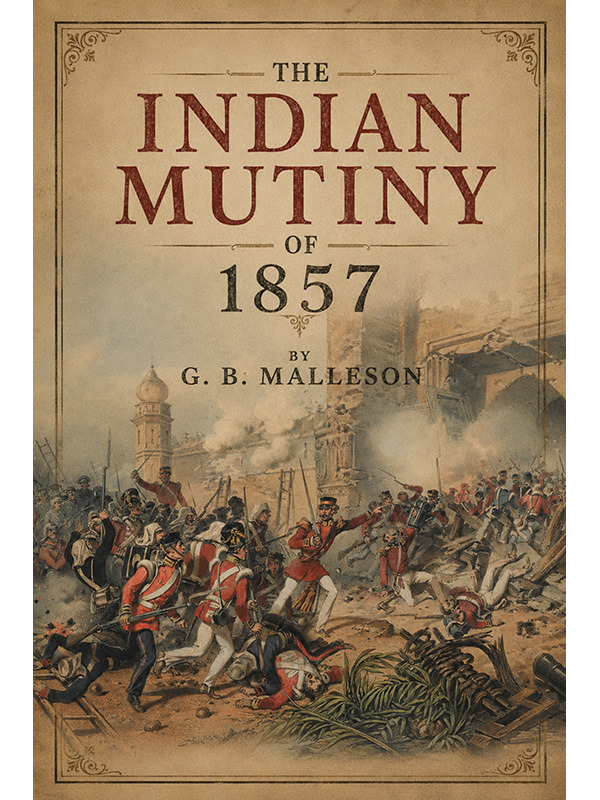
By G. B. Malleson. The Indian Mutiny of 1857 was one of the most dramatic upheavals of the nineteenth century—a revolt that erupted with astonishing speed, engulfed vast areas of northern and central India, and brought British rule on the subcontinent perilously close to catastrophe. In this classic history, Colonel G. B. Malleson tells the extraordinary story of the uprising from its origins to its final suppression.
Beginning with the growing unrest within the Bengal Army and the political grievances that Malleson believed lay behind it, the narrative follows the first outbreaks at Barrackpur and Mírath, the seizure of Dehlí, and the rapid spread of rebellion across northern India. From there unfolds an epic succession of sieges, battles, massacres, desperate marches, and remarkable acts of endurance.
Malleson recounts the tragedy at Kánhpur, the defence and relief of Lakhnao, the siege and storming of Dehlí, the campaigns of Havelock and Sir Colin Campbell, and the struggle against such celebrated rebel leaders as Náná Sahib, the Rání of Jhánsí, Kunwar Singh, and Tántia Topí. The story ultimately ranges across Oudh, Rohilkhand, Central India, and beyond as British forces gradually re-established control.
What gives Malleson’s history particular importance is his personal connection with the events he describes. Serving in India before and during the Mutiny, he witnessed the growing discontent among the sipáhís and later recalled that his warnings about their increasingly dangerous mood had been dismissed. During 1857 he kept records of developments as they occurred and published an anonymous contemporary analysis, The Mutiny of the Bengal Army. In later years he supplemented these observations through extensive research and discussions with Indian participants and witnesses.
The result is far more than a chronicle of battles. Malleson attempts to explain why the explosion occurred, how it spread with such extraordinary rapidity, and why British authority survived.
His conclusion also provides a fascinating insight into the mentality which drove the British Empire: an abiding faith in British supremacy, and in that empire’s right to bring civilization to the world. He belonged to an era which, despite its achievements, failed to understand racial dynamics, and his conclusion that the Indians “want” British rule as preferable to their own sums up the racial error of that time.
Completely reset and meticulously proofed and restored.
About the Author: Colonel George Bruce Malleson, C.S.I. (1825–1898) entered the Bengal Army in 1842 and served during the Second Anglo-Burmese War before joining the Commissariat and Military Audit departments. In 1857 he was serving in Calcutta, where he closely followed and wrote about the uprising; afterwards he rose to senior administrative positions in India before retiring in 1877 and establishing himself as a prolific historian of India and military affairs.
Paperback, 348 pages.
Contents
Preface
Chapter I: Introductory
Chapter II: The Conspirators
Chapter III: The First Mutterings of the Storm
Chapter IV: The Spread of the Epidemic
Chapter V: Barrackpur, Calcutta, and the North-West to the 9th of May
Chapter VI: The Revolt at Mírath and the Seizure of Dehlí
Chapter VII: The Effect, Throughout India, of the Seizure of Dehlí
Chapter VIII: The Progress of the insurrection in the North-West in May and June
Chapter IX: The March to Dehlí
Chapter X: Kánhpur, Lakhnao, and Allahábad
Chapter XI: Calcutta in June and July
Chapter XII: The Leaguer of Kánhpur
Chapter XIII: Neill at Banáras and Allahábad—Havelock’s Recovery of Kánhpur
Chapter XIV: The Residency at Lakhnao After Chinhat—Havelock’s First attempts to Relieve It
Chapter XV: Calcutta and Western Bihar in July and August
Chapter XVI: The First Relief of the Lakhnao Residency
Chapter XVII: The Leaguer of Agra
Chapter XVIII: Events in the Sagar and Narbada Territories, Central India, Rájpútána, The Mírath Districts, Rohilkhand, and the Panjáb
Chapter XIX: The Siege and Storming of Dehlí
Chapter XX: From Dehlí to Agra and Kánhpur—Sir Colin Campbell at Kánhpur
Chapter XXI: The Second Relief of the Lakhnao Residency—Windham and the Gwáliár Contingent
Chapter XXII: Sir Colin Campbell Recovers the Duáb
Chapter XXIII: Eastern Bengal, Eastern Bihár, Ázamgárh, Allahábád, and Eastern Oudh
Chapter XXIV: The Storming of Lakhnao
Chapter XXV: Ázamgarh—Reconquest of Rohilkhand, of Oudh, of the Ázamgarh and Western Bihár Districts
Chapter XXVI: Western and Central India
Chapter XXVII: The Last Embers of the Revolt
Chapter XXVIII: Conclusion
Illustrations
Sir Colin Campbell, afterwards Lord Clyde.
Lord Canning, Governor-General of India, 1856 –1858.
Sir Henry Lawrence.
Sir Henry Havelock.
Sir James Outram.
Plan to Illustrate the Operations of the British Army before Delhi in 1857.
Sketch of Operations for the Relief and Withdrawal of the Lakhnao Garrison.
Plan to Illustrate the Operations before Lakhnao in March 1858.