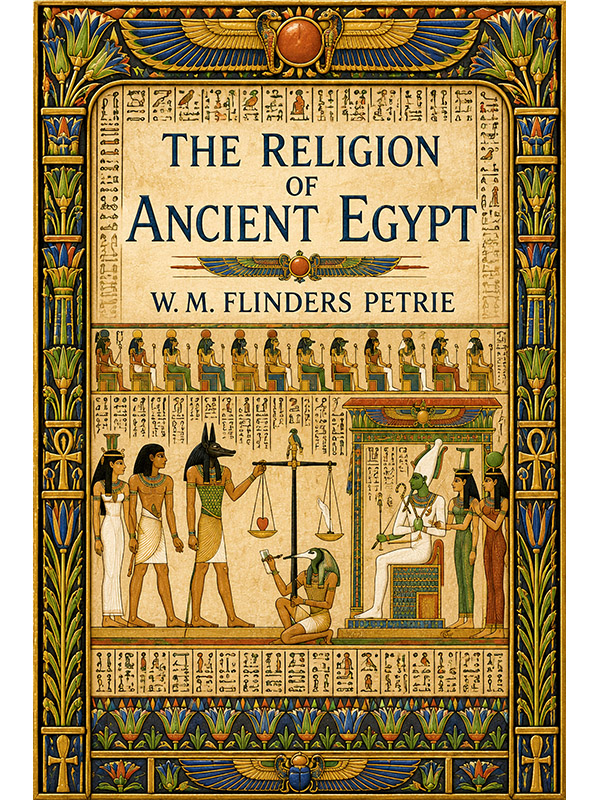
Description
By W. M. Flinders Petrie. One of the most influential Egyptologists and archaeologists of all time examines the beliefs that shaped one of history’s longest-lasting civilizations. Drawing upon decades of excavation and firsthand study, Petrie explains Egyptian religion not as a collection of isolated myths, but as a system that developed and changed over thousands of years.
Petrie begins by tracing the earliest religious ideas of the Nile Valley, exploring how local cults, tribal traditions, and regional deities gradually evolved into a more complex and organized religious structure. He examines the principal gods and goddesses of Egypt, explaining their origins, attributes, symbols, and relationships with one another.
Particular attention is given to the role of the pharaoh, who occupied a unique position as both ruler and sacred figure. Petrie also discusses the Egyptian priesthood, temple rituals, offerings, sacred ceremonies, and the elaborate religious institutions that governed daily life.
One of the book’s most valuable sections concerns Egyptian beliefs about death and the afterlife. Petrie describes funerary customs, mummification, tomb construction, burial practices, and the religious texts intended to guide the deceased through the next world. The significance of the soul, judgment after death, and the hope of immortality are examined in clear and accessible language.
Petrie also investigates how religion influenced Egyptian society, morality, government, art, and architecture. His archaeological experience allows him to connect surviving monuments and artifacts with the religious ideas that produced them.
Combining historical scholarship with evidence gathered from the ancient sites themselves, The Religion of Ancient Egypt remains an important introduction to the spiritual foundations of one of the world’s most remarkable civilizations.
Contents
Chapter I: The Nature of Gods
Chapter II: The Nature of Man
Chapter III: The Future Life
Chapter IV: Animal Worship
Chapter V: The Groups of Gods—Animal-Headed Gods
Chapter VI: The Human Gods
Chapter VII: The Cosmic Gods
Chapter VIII: The Abstract Gods
Chapter IX: The Foreign Gods
Chapter X: The Cosmogony
Chapter XI: The Ritual and Priesthood
Chapter XII: The Sacred Books
Chapter XIII: Private Worship
Chapter XIV: Egyptian Ethics
Chapter XV: The Influence of Egypt
Principal Works on Egyptian Religion
Index
About the author: Sir William Matthew Flinders Petrie, FRS (1853–1942), commonly known as Flinders Petrie, was England’s most famous Egyptologist who pioneered systematic methodology in archaeology and preservation of artefacts. He was the first chair of Edwards Professor of Egyptian Archaeology and Philology at University College London, where his large collection of Egyptian antiquities is now housed.
58 pages. Paperback.